

Solar Roof Integration work in San Diego starts with roof condition, access, drainage, existing assembly, occupant impact, and whether repair, restoration, maintenance, or replacement is the practical next step.
Request a quoteWe do not sell or wire photovoltaic arrays. What we do is make sure the roof underneath one is ready to carry it for the next two and a half decades. On a commercial building, the panels are the part everyone photographs, but the part that decides whether the project ages well or turns into a recurring leak call is the membrane below the racking. We get brought onto solar jobs around San Diego as the roofing conscience in the room: the contractor whose only stake is that the roof stays watertight long after the array is energized.
The pull toward rooftop solar here is straightforward. Acres of flat, sun-baked low-slope membrane sit on the distribution buildings off Otay Mesa Road and Siempre Viva, on the warehouse rows feeding the I-805 and I-15 freight corridors, on the lab and office campuses up in Sorrento Mesa and along Mira Mesa Boulevard, and on a long list of municipal and Port of San Diego facilities. Between the federal Investment Tax Credit and SDG&E's net energy metering, the generation math pencils out, and owners understandably want modules up quickly. Our job is to slow down for the one question that gets skipped: is the roof actually a good place to mount them.
The most expensive mistake on a commercial solar project is bolting a twenty-five-year array to a roof with eight years left in it. Once panels and racking cover the field, replacing that membrane means a solar contractor has to come back, de-energize, disconnect, and remove the entire system, then reinstall it after the reroof — a five-figure dance that should never have been necessary. So before a single module is ordered, we core the existing assembly, check the membrane's condition and fastening, and give you a straight read on how many years it has left.
If the roof is near the end of its life, we make the case to recover or replace it first and set the array on a clean surface that will outlive the panels. If it has fifteen or twenty good years ahead, we say so and get out of the way. Either way, the recommendation is grounded in what the core samples actually show, not in a desire to sell you a reroof you do not need.
Two attachment strategies cover almost every flat roof in San Diego, and each one trades a roofing problem for a structural one. Ballasted racking holds the array in place with concrete weight and never punctures the membrane, which keeps things watertight but loads the deck heavily. Mechanically attached racking anchors through the membrane into the structure, which is far lighter but converts every standoff into a flashing detail that has to stay sealed for the life of the system. We do not pick one in isolation. We weigh what the building can carry, what the membrane manufacturer will warrant, and how the panels are laid out, then coordinate the attachment method directly with your solar installer so the racking plan and the roofing plan tell the same story.
Membrane chemistry sets real limits here. Plasticizer in a PVC sheet will migrate into the wrong protection pad and stiffen the membrane exactly where you can no longer reach it; an unprotected metal foot will abrade a TPO seam over a couple of summers. We specify the slip sheets, protection courses, and walk pads the membrane maker actually approves, and we keep racking hardware off the seams and clear of drains, curbs, and crickets.
San Diego's basic design wind speeds are mild next to hurricane country, but a ballasted array is still very much a wind problem. An uplift event does not need to throw a panel off the parapet to cause damage — it only needs to slide a ballasted system far enough to drag the racking across the membrane and tear it. Ballast layouts have to be engineered to the building's height, parapet, and roof zones, with extra weight concentrated at the corners and along the perimeter where uplift forces peak. On the structural side, the dead load of ballast plus modules has to be checked against the building's real capacity. On older San Diego commercial structures designed to lighter original loads, that check is not a rubber stamp, and we will not bless a ballast plan the deck cannot carry.
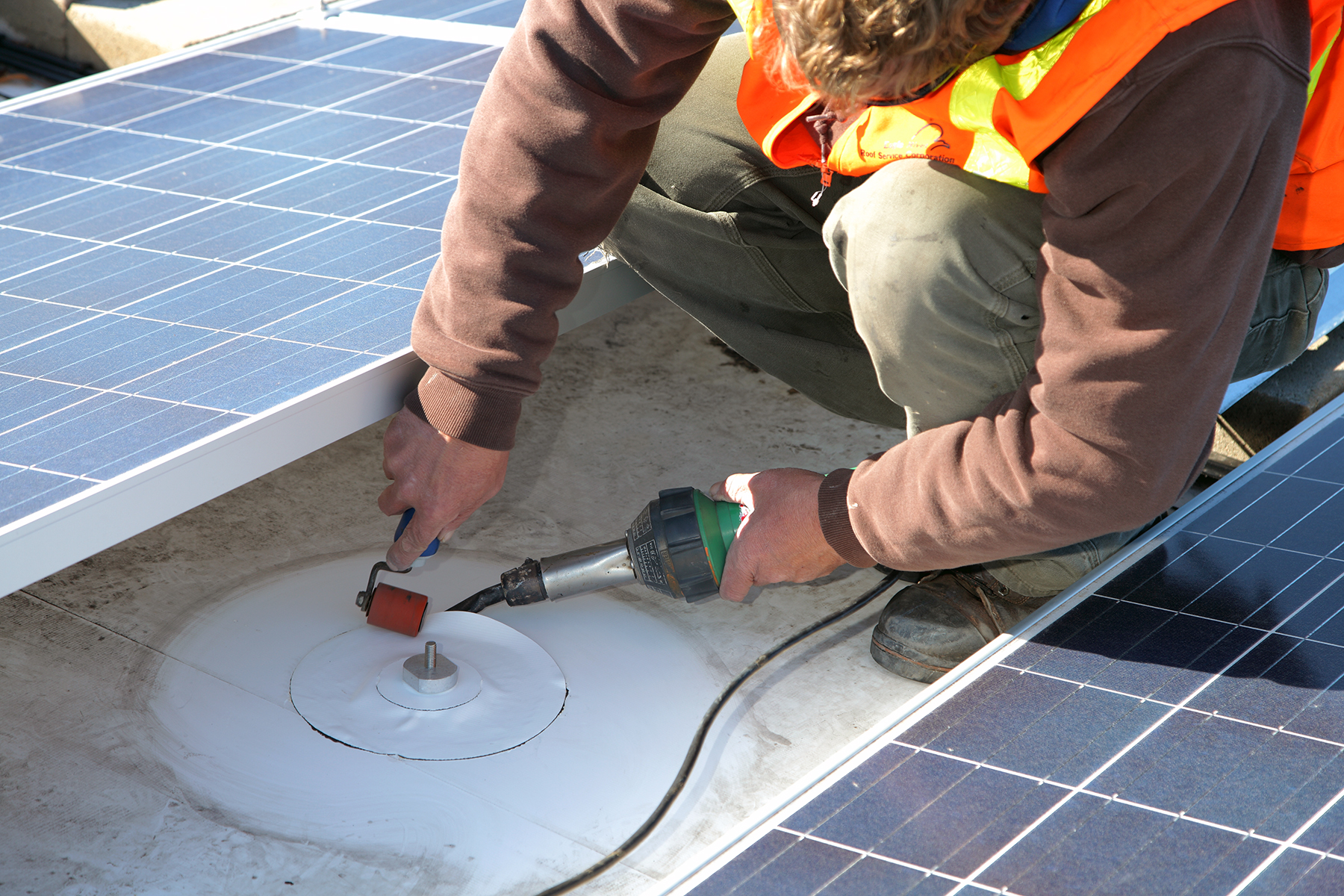
When a solar install starts leaking two years in, it is almost never the panels. It is the conduit runs, the combiner-box curbs, and the homeruns that got punched through the roof on a schedule that suited the electrician and nobody else. Conduit strapped flat to the membrane saws at it every time the deck moves; a penetration sealed with a generic rubber boot instead of a properly flashed pitch pocket turns into a slow drip. On our solar jobs, we flash every roof penetration ourselves, to the membrane manufacturer's published detail, and we settle the conduit routing in preconstruction so it runs on approved supports above the membrane rather than dragging across it.
The real reason a solar array needs a roofer who talks to the solar installer comes down to warranty. A manufacturer's membrane warranty can evaporate the moment an unapproved trade penetrates the roof or sets hardware on it without sign-off. So we bring the membrane manufacturer's field representative into the project before the array goes up, get the racking and penetration details reviewed and approved, and make sure every roof-touching scope keeps that warranty in force. The PV equipment carries its own warranty from its own manufacturer; the roof carries the membrane warranty. Our entire role is to make certain that energizing one does not quietly void the other.
If you are weighing solar on a San Diego warehouse, distribution center, office park, or municipal roof, the cheapest version of the project is the one where the roofer and the solar contractor are at the table together from the start. Call us during planning. We will tell you plainly whether the roof is ready, what it can carry, how the array should attach, and how to keep both warranties whole — so the only thing your building generates after the panels go live is power.
Solar Roof Integration is scoped around coastal metal exposure, San Diego access limits, rooftop equipment, tenant protection, drainage, and what the owner needs to decide next.
Start a Request
A practical roof scope tells the owner what is urgent, what can wait, what needs testing, and which details change the budget.
San Diego roof work should account for marine air, reflective roof requirements, tenant operations, drainage, and rooftop service traffic.
Photos tied to roof areas, drains, penetrations, and sheet metal
Repair, coating, recover, replacement, and maintenance paths separated
Access, staging, tenant notices, work hours, and daily dry-in reviewed